


How Chana Roasting and Flavouring Machines Improve Snack Production
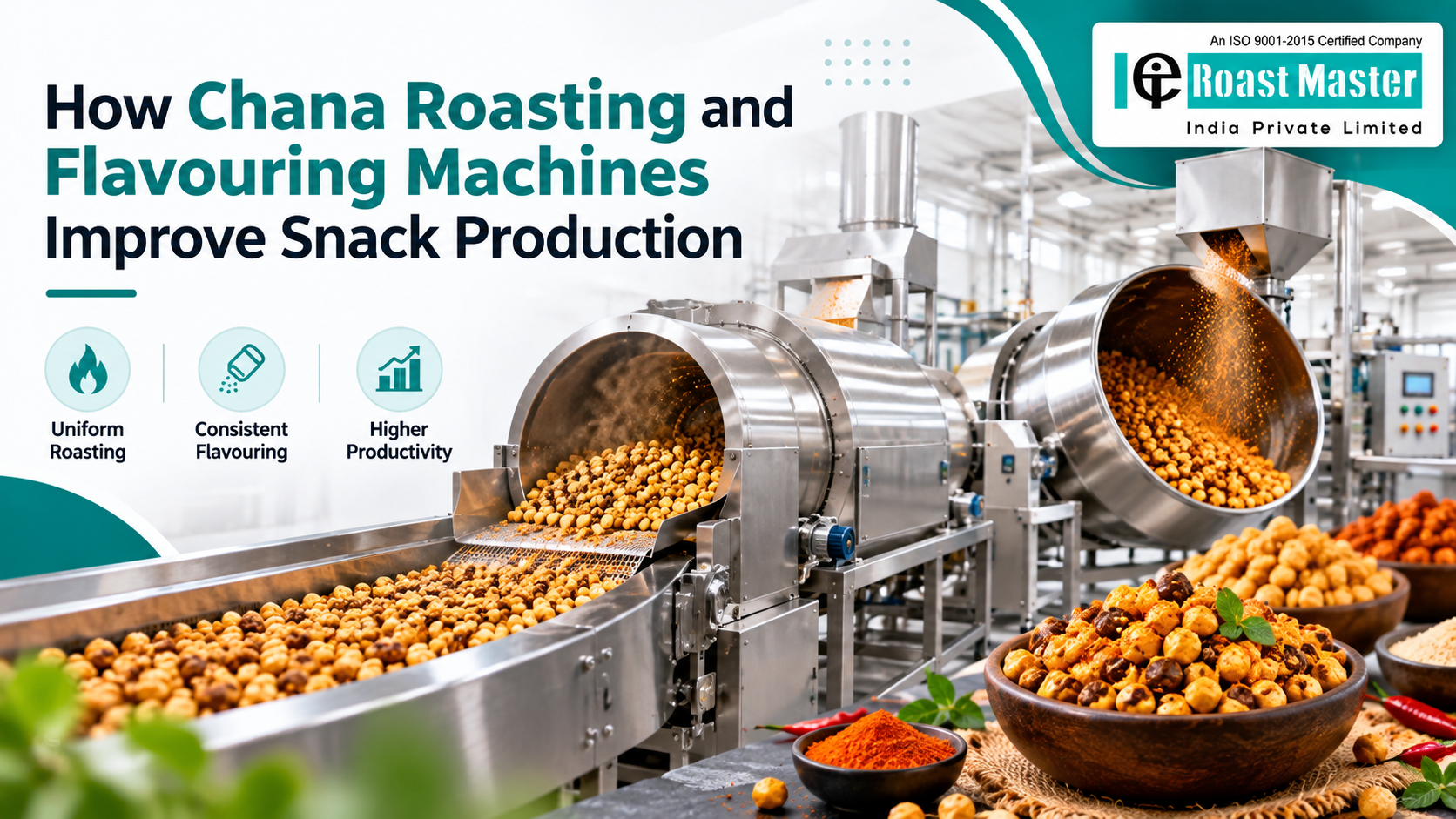
Newer equipment used for roasting and seasoning chana helps processors to automate these processes, and improve their consistency, production and hygiene. For businesses entering the sector, an integrated processing system is often more reliable than customary, individualized equipment for roasting and seasoning.
What Is a Chana Roasting and Flavouring Machine?
A chana roasting and flavoring system is a system for roasting and flavoring chickpeas, so that the final roasted chickpeas have the desired aroma, texture and taste. The seasoning is added during the flavoring stage to salt, spices, masala powders or other flavorings depending on the product formulation.
Roast Master India machines also come with chana roasting in the product lines. There are chana cracker roasting and flavoring lines available on the website that roast and flavor the chana in a controlled manner to achieve even roasting and flavoring. Models with 300, 500, 700 and 1000 kg/hr capacities use gas/oil heating.
Consistent Roasting Quality
One of the major challenges in preparing chana is to roast chickpeas evenly, or the mixture may be of uneven colour, crunch and flavor when some chickpeas may be under-roasted while others are over-roasted.
Modern roasters use controlled heaters and produce a continuous material flow to expose the product to heat more uniformly, such as continuous roasters. The benefits of continuous roasting technology for roasted chickpea machines are uniform heat transfer, continuous product flow and temperature control according to Roast Master India (roastmasterindia.com).
Consistent roasting is helpful for manufacturers:
- Uniform colour
- Better roasted aroma
- Consistent crunchiness
- Less chance of burning
- Repeatable product quality
This is especially important for mass-marketed snacks which must have the same taste and texture regardless of the processing batch.
Improved Production Efficiency
Manual methods of roasting can therefore require a good deal of labour and constant attention, and be difficult to scale up.
However with an automatic or continuous chana roasting line manufacturers can increase throughput without a corresponding increase in labor, as the automation of these processes provides a constant flow of work through the roasting chamber and a more evenly distributed and predictable output.
This more efficient processing allows businesses to:
- Increase production capacity
- Reduce processing bottlenecks
- Minimize manual handling
- Improve production planning
- Handle larger commercial orders
This is especially useful for growing snack manufacturers, because it allows them to scale up production without increasing manual operations.
Better Control Over Roasting Temperature
Temperature is an important factor for roasted chana production. At a higher temperature, the chana could get burnt or have an undesirable colour. If the temperature is too low, the chana is under-roasted, which affects the flavor of the dish.
Roast Master India utilizes controlled conditions or temperature-controlled roasting to achieve uniform roasting. These conditions can be adjusted while the operator is roasting, depending on the raw material and the roasting characteristics desired.
Thus temperature control can help improve:
- Aroma development
- Colour consistency
- Texture
- Roasting uniformity
- Product quality
Uniform Flavor Distribution
Roasting is only one part of the process of making a successful flavored chana snack; the spices should be evenly distributed.
If flavoring is non-uniform, chips in a batch may be over-flavored by salt or spice while others may have too little. A dedicated flavoring system can deploy the oil and dry seasoning more uniformly.
The core technology of Roast Master India's seasoning is termed controlled and uniform application of flavoring agents. The company's infrastructure for its seasoning line states that controlled application of oil and seasoning can reduce waste and increase flavor consistency.
Several different types of recipes can be used, including:
- Salted chana
- Masala chana
- Spicy roasted chana
- Peri-peri chana
- Chatpata chana
- Custom seasoning blends
Reduced Labour Requirements
Traditionally, temperatures are monitored and the product is mixed, and moved from the roaster, with workers sprinkling or mixing in the seasoning manually.
Because fewer manual tasks are required, automation can help manufacturers to use their labor more efficiently and can lower the risk of human error.
Automated processing can provide:
- Less manual intervention
- More consistent processing
- Less reliance on skilled labour
- Reduced product handling
- Better production control
The level of automation possible is often dictated by the production requirements and plant layout.
Improved Hygiene and Food Safety
Hygiene is important in any commercial food processing, and the risk of contamination increases with product handling, such as excessive manual working of the product.
Equipment that is used in food processing that has food-grade product contact surfaces may be easier to clean. Roast Master India describes its roasting machines as food-grade stainless steel with hygienic processing of products as a top priority.
Cleaner, more controlled processing environments can help manufacturers to achieve a consistent quality of product and meet their own hygiene standards.
Better Utilization of Seasoning Materials
Flavoring ingredients represent an important portion of the production costs of flavored snacks, and excessive and insufficient amounts lead to higher cost and flavor failure.
Controlled seasoning systems can help manufacturers by controlling the amount and distribution of the oil and other ingredients used in the seasoning, reducing waste, and achieving recipe consistency.
Especially when produced in large quantities, even small improvements in the use of seasoning can improve efficiency.
Large-Scale Snack Production Capacity
As demand for roasted snacks rises, manufacturers need to be able to produce large quantities. A continuous roasting and flavoring line can be included as an integral part of the food processing industry as a batch of raw materials are fed, roasted and flavored, cooled and packaged.
According to its website, Roast Master India is a food processing and packaging machinery company with over 25 years of experience. The company has over 200 customers and 30 products, with plants located worldwide.
This is helpful to manufacturers selling into wholesalers, retailers, distributors and large snack brands.
Flexible Product Development
Consumer preferences for snack flavors vary over time, so manufacturers might want to try new seasoning combinations without having to change the whole setup.
A modular flavoring system can allow a snack producer to switch from product to product, producing many different kinds of roasted chana for various consumer tastes, while using the same roasting and flavor-improving construction.
For example, manufacturers can produce product lines of:
- Mild or strong spice levels
- Salt-based seasonings
- Masala blends from India
- International spice profiles
- Premium or specialty flavor combinations
How Does a Chana Roasting and Flavoring Line Work?
A typical production process may include several stages:
Step 1: Raw Material Feeding
The chana is fed into the system following cleaning and preparation.
Step 2: Controlled Roasting
The chickpeas are passed through a roasting compartment, where they are heated (thus the roasted characteristics).
Step 3: Cooling
The roasted product may be cooled, if required by the production configuration, before flavoring and/or other processing.
Step 4: Oil Application
An oil or other liquid ingredient may be applied in small amounts to provide a source for the seasoning to adhere.
Step 5: Flavoring
The roasted chana is mixed with salt, spices or seasoning blends to impart flavor.
Step 6: Mixing and Discharge
For a more uniform product, the material is mixed and then discharged for the next step of processing.
The process and equipment configuration may vary depending on the product, the capacity, the seasoning recipe and the plant.
Why Should You Opt for an Automated Chana Roasting and Flavoring Line?
Increasing production capacity is an important driver for most snack food manufacturers, but consistency of production quality, minimizing the consumption of labor, energy and raw materials and reducing the complexity of manufacturing processes are also major drivers for equipment selection.
Thus, a chana roasting and flavoring line can provide:
- Consistent roasting
- Uniform flavor coating
- Improved production efficiency
- Reduced manual handling
- Better temperature control
- Improved hygiene
- Reduced seasoning wastage
- Scalable production
- Greater product consistency
Conclusion
Chana roasting and flavoring machines enable production line workers to roast and flavor chana in a controlled, uniform way, resulting in consistency of appearance, crunchiness, fragrance and flavor of chana, which in turn reduces the dependency on manual labour.
Equipment for new roasted chana production lines or expansions must be selected based on production capacity requirements, product specifications, level of automation desired, and seasoning specifications.